In 2026, Lake Management, Inc. (LMI) was contracted by the Lake Owasso Association (LOA) to provide aquatic vegetation control services. The Minnesota Department of Natural Resources (DNR) issued permits 16F-3A965, 2026-1914, and 2026-1953, authorizing a combined 24.23 acres of shoreline control.
LMI scheduled the initial application based on plant development. Shoreline treatments were conducted on June 9, 2026, for 157 individual homeowners. Treatments targeted curly-leaf pondweed (CLP), where present, as well as slender naiad, large-leaf pondweed, elodea, algae, and limited amounts of other native aquatic vegetation. Flumioxazin, diquat, and algaecides were applied along approximately 7,909 feet of shoreline. Eleven properties received permitted lily control using carfentrazone.
Two additional Minnesota DNR permits, 2026-1914 and 2026-1953, were issued for homeowners not included under the primary permit (16F-3A965). Together, these permits covered 1,045 feet of shoreline for 20 homeowners. Initial shoreline treatments for these properties were conducted on July 2, 2026; one additional homeowner received service on July 17, 2026.
LMI conducts inspections on Lake Owasso and uses the resulting observations to provide treatment recommendations to the LOA. Under the 2026 DNR permit, individual properties were eligible for up to two nuisance aquatic vegetation control applications. Based on inspection findings and input from homeowners and the LOA, secondary applications were not necessary in 2026.
Summary
Lake Owasso continues to support a diverse community of native aquatic plant species. Although populations and densities fluctuate annually, native vegetation showed little change from 2025 to 2026. Naiad, large-leaf pondweed, flat-stem pondweed, elodea, and water lily remain the most frequently observed species.
The 2024 whole-lake fluridone treatment was successful in reducing Eurasian watermilfoil (EWM) to undetectable levels in 2026. No EWM was identified during LMI surveys or treatment activities.
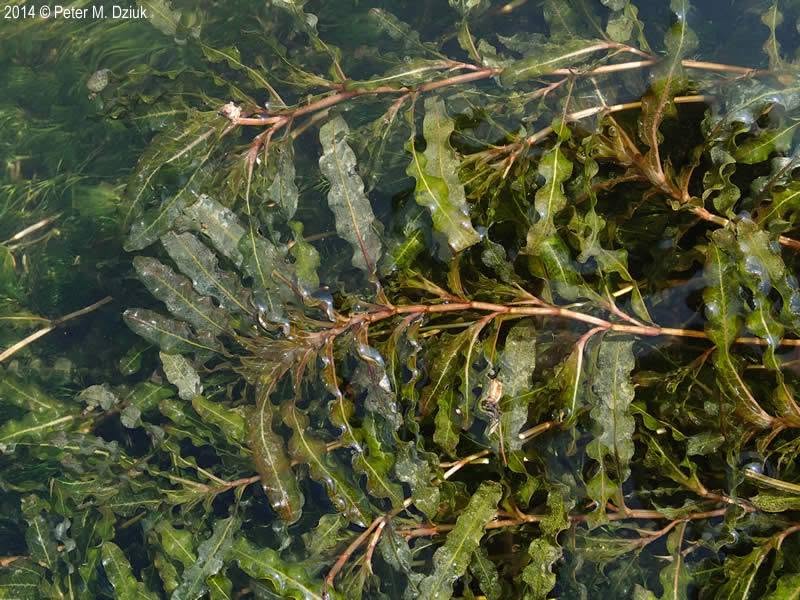
The invasive curly-leaf pondweed (CLP) increased significantly in 2026. CLP is an early-season plant that forms dense canopies and surface mats, and it has been documented in Lake Owasso for more than 40 years. Environmental conditions influence its frequency and density, and robust growth was observed across area lakes in 2026. Favorable growing conditions, combined with reduced competition from EWM, likely contributed to the increase.
For 2027, LMI recommends submitting CLP permit applications for offshore areas more than 150 feet from shore in January. This schedule should provide the Minnesota DNR sufficient time to issue permits before the targeted early-May treatment window.
LMI also recommends submitting homeowner shoreline permit applications in late February or early March. This timing should allow initial treatments to occur in mid-to-late May and support targeted control of CLP in nearshore areas. Treating CLP before it produces reproductive turions offers the most effective approach for reducing its abundance throughout the lake.
LMI recommends continuing surveys for aquatic invasive species and native vegetation. Survey data should be used to support permit applications, enable rapid responses to invasive species, and evaluate long-term vegetation trends.
Lake Management, Inc